Print
PrintAppearing as a central voice on a national radio broadcast about health care was nerve-wracking, but worth it
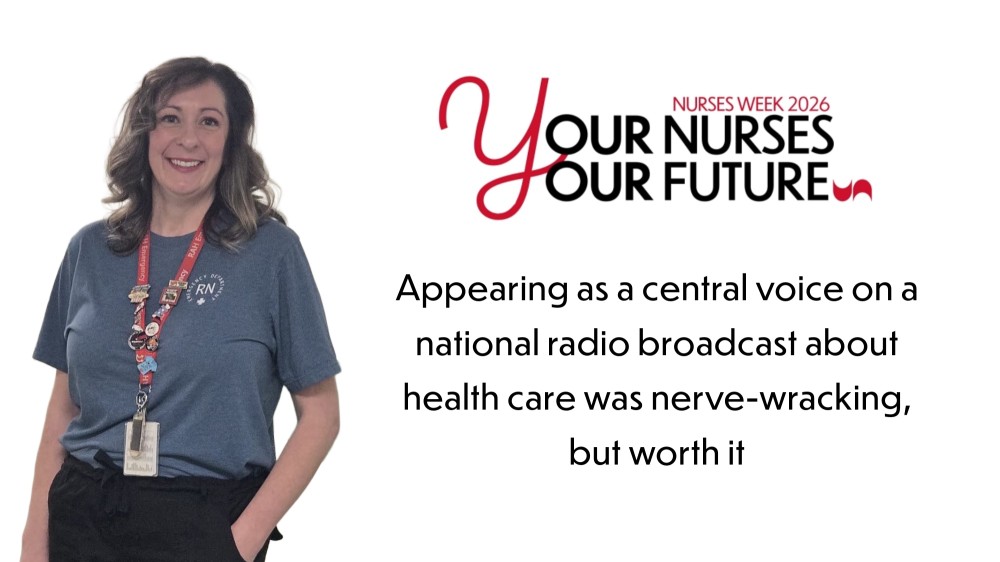
It’s not every day front-line nurses are asked to take part in an in-depth interview for a radio broadcast that would be heard in every part of Canada. You might even think the thought of such a thing would be nerve-wracking.
That’s certainly the way Registered Nurse Valerie Evanishen felt last January when she was asked along with her colleague Jayme Hack to appear on Dr. Brian Goldman’s CBC program, White Coat Black Art, to talk about the state of the Emergency Department at the Royal Alexandra Hospital in Edmonton where they work.
“I’m not the type of person who likes to go and do these kinds of things,” Evanishen said quietly. “I can do it, but I don’t want to do it. So it was very nerve-wracking at first. But I also had confidence because I had Jayme with me too, so I really took a lot of strength from that.”
Evanishen underestimates her skills as a communicator. She speaks quietly, but with real passion about her work, and with a thoughtful understanding of the risks of taking on a public advocacy role when engaged in a front-line public health care job.
It helped, Evanishen recalled, that the staff producing Goldman’s CBC show were thoroughly professional and used to working with people who are not seasoned public speakers. CBC staff were careful to ensure the two members of UNA Local 33 were willing to let them use their names. They also assured the two nurses that they could ask to go back and give an answer again if they were unsatisfied with the way they’d spoken. “That took a lot of pressure off,” Evanishen remembered.
When the show aired, it brought a powerful message to the public about what front-line nursing staff face everywhere in Canada in the country’s crowded Emergency Departments. “Once I listened to it, I was like, wow, they really did a good job of putting that together. It was really well thought out. It flowed well. I think they utilized Jayme’s strength and answers along with mine and put something together that I ended up being really proud of.”
“It was really very rewarding” she added. “Countless people, physicians and other nurses, friends, family, all reached out and said that they had listened, that they felt like I was a very compassionate person working a very hard job, and just congratulated me. From my perspective that was really great.”
Nurses must be careful about how they describe their working conditions to media, Evanishen noted, and they need more protection to be able to speak their minds. “Nurses should be able to say what they’re experiencing in the health care system for the protection of the public,” she explained. “The public needs to know when nurses raise alarms about what’s happening.”
Nurses know what’s going on, and they have solutions to offer. “If you don’t have a voice to raise public awareness, the public is missing a whole piece of the problem,” she said.
Evanishen grew up in Edmonton in “a family of accountants … no nurses in my family at all.” She was interested in a more public-facing role than accounting and went to university considering a career in the police. She didn’t want to take a degree that was too abstract, though. “So I went into first-year nursing thinking that, after four years, I’m going to go into the police.”
That isn’t the way it worked out. After a year of nursing education, she said, “I wasn’t looking at anything else. I loved every minute of it. When I look back on my four years of training, I didn’t feel like it was hard. I think it was because I loved so much what I was doing that it didn’t feel like work.”
Evanishen graduated in 2002 and went to work at the Fort Saskatchewan Community Hospital on the advice of a university instructor who said she she would be able “to do a little bit of all different types of nursing.”
She worked there until 2006, when she moved to the Royal Alex in Edmonton’s downtown where she has worked ever since. “I like the variety that I get in an Emergency setting. I like that every day is different, and that I’m constantly learning and constantly challenged. At the same time, I’ve been there long enough that I also feel accomplished, that I know what I’m doing.”
Evanishen says she worries the stress of overcrowded Emergency Departments, and the trend of growing violence, will drive young nurses out of the profession. “It used to be few and far between that you would be verbally abused or physically threatened. Now it’s a daily occurrence.” She also feels empathy for sick and the family members, forced to wait hours to see a doctor, not getting their needs met when they should be.
“I hope that the love of nursing will keep people in the toughest of jobs,” she said. “That just loving the job and the passion that comes with it, that passion will keep us going.”
And nurses need to stand up for what they believe in and stand up for each other, she concluded. “We need to be heard. We need to speak.”